
A self-developed ceramic slurry 3D printer turns brackets from tooling-dependent parts into digital components that can be revised overnight.
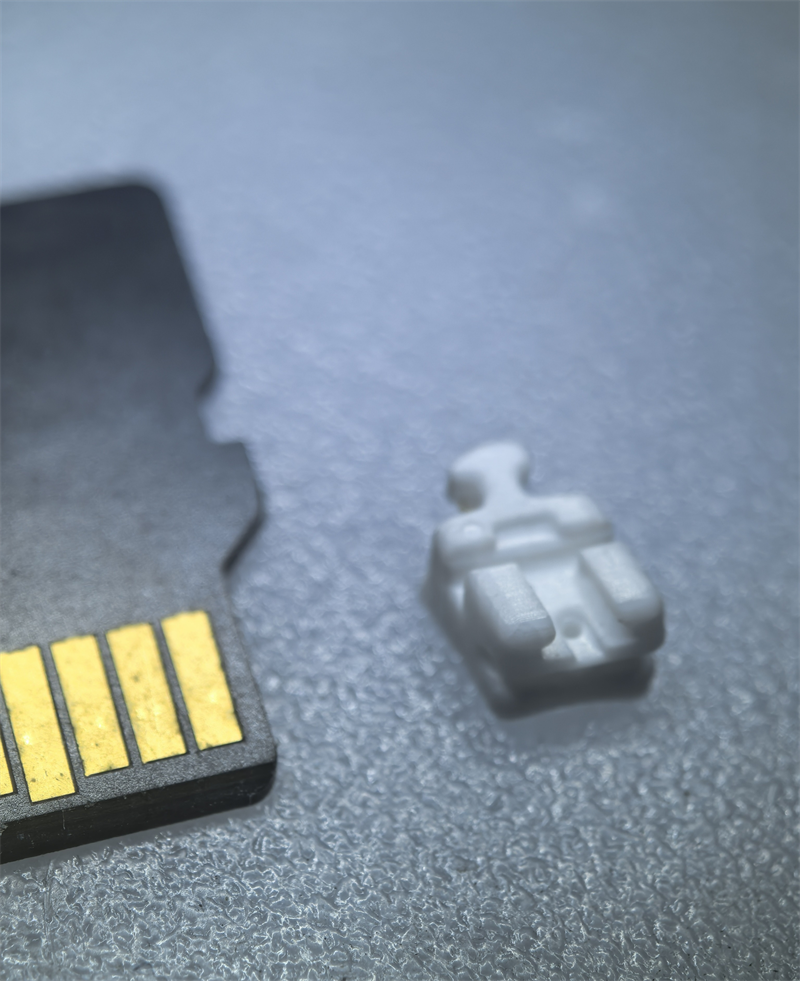
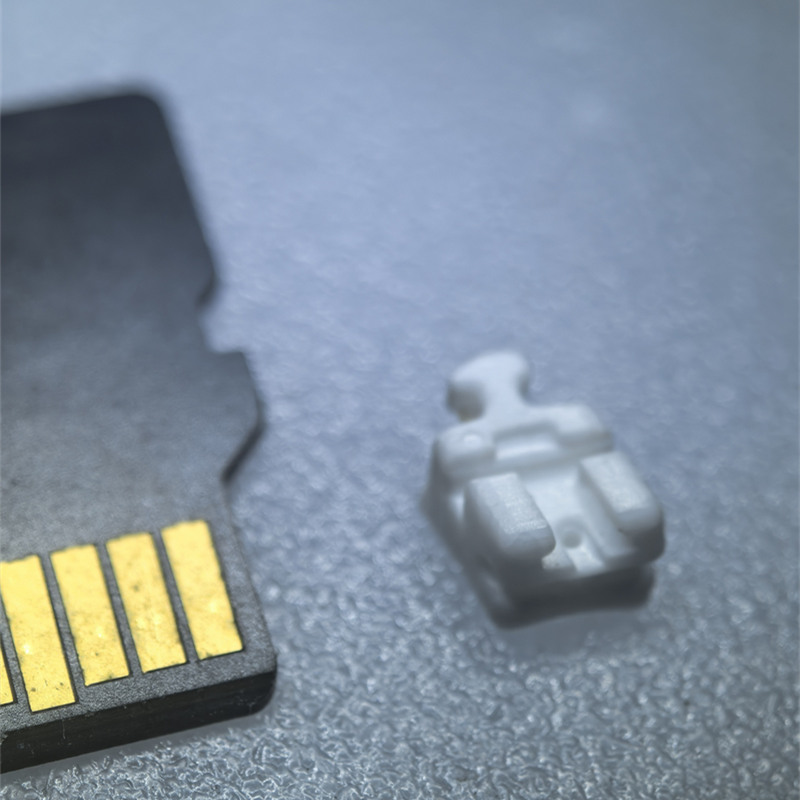
A sintered zirconia bracket beside a memory card. Millimeter-scale geometry with clean edges is the most direct evidence of 10 μm-class print resolution.
An orthodontic bracket looks simple. It is not. The slot must seat an archwire. The wings must hold a ligature. The base must follow the tooth face and still provide retention. On a conventional route, that means steel tooling. Change an undercut or the curvature of the pad, and you wait for a new mold.
We moved the same part onto a ceramic slurry 3D printer developed in-house — photocuring a high-solids zirconia slurry, then washing, debinding and sintering — to produce brackets that can go straight into post-process evaluation. The brief is specific: put the precision into the slot and the base, and turn a design change from “wait for tooling” into “edit the file.”
In one sentence
The same digital process can print labial aesthetic brackets and low-profile lingual brackets. Geometry changes do not require steel molds. Small batches and multiple versions can be validated in parallel.
Ceramic brackets have been in the clinic for decades. Both alumina and zirconia have been used to reduce the metallic look of fixed appliances. Zirconia is attractive because strength and toughness are better balanced, the color can be tooth-shade or high-white, and the biocompatibility path is mature — a reasonable candidate for a load-bearing part bonded in the mouth for months.
For additive manufacturing, though, a bracket is one of the least forgiving ceramic parts:
• The whole part is only a few millimeters across. Slot, wings and undercuts share a very small envelope.
• Slot cross-section governs wire seating and friction. A small dimensional drift changes the clinical feel.
• The base needs a retention pattern — mesh, undercuts, micro-texture — and still has to sit against enamel.
• Labial designs favor aesthetics and ligation; lingual designs favor a low profile and comfort. One “bracket” is really two design languages.
Injection molding is excellent at repeating a frozen design at high consistency. It is poor at “we need another base curvature next week.” The point of 3D printing here is to give that freedom back to design — not to claim it replaces every production route.
Photocuring a ceramic slurry is not “pour powder into a machine.” What decides the finished part is slurry rheology, exposure and layer thickness, green-body strength, and whether debinding and sintering shrinkage stay predictable. We treat that entire chain as one in-house process.
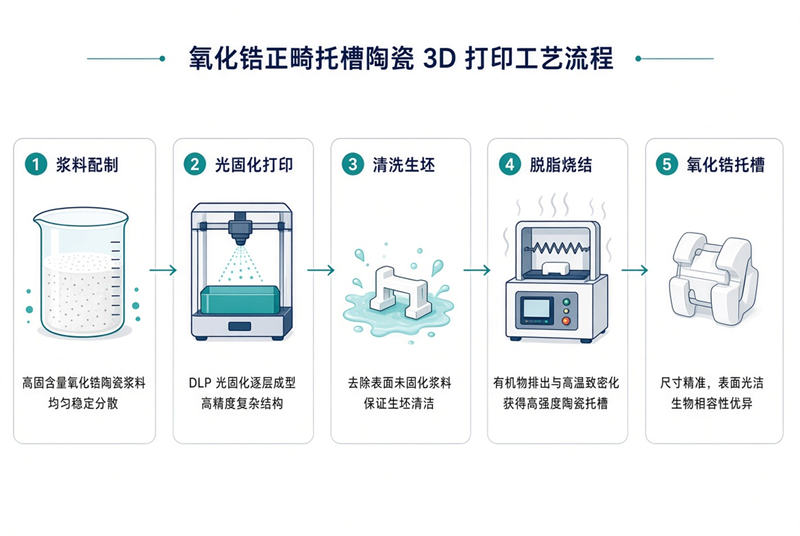
Process schematic for zirconia brackets: slurry preparation → vat photopolymerization → green-body wash → debinding and sintering → finished ceramic.
Slurry: printable first, dense after firing
A zirconia slurry has to carry a high solids loading, remain coatable and exposable, and still leave a green body strong enough to handle. Solids too low and sintering shrinkage becomes hard to control. Viscosity too high and the slot and the mesh base will not fill. We develop the slurry as part of the printer, rather than dropping a generic resin formula onto a dental part.
Printing: 10-micron precision where it matters
The figure we quote externally is 10-micron precision. On a bracket that is not a slogan. It is whether the slot wall, the wing root and the micro-features on the base can be written stably. Layer thickness, pixel pitch and exposure have to match the cure depth of the slurry. Undercure leaves a soft body; overcure floods the undercuts.
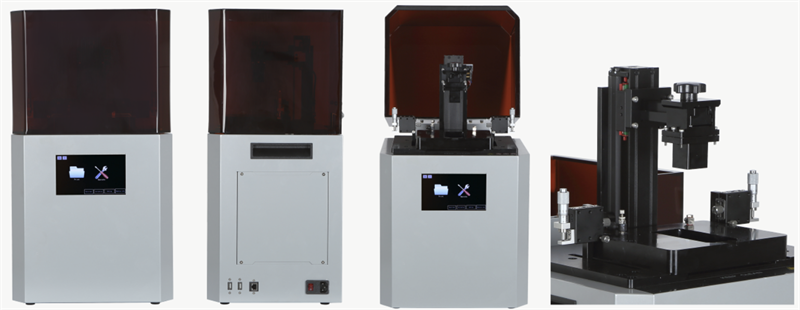
Full printer photo — exterior / build chamber / vat
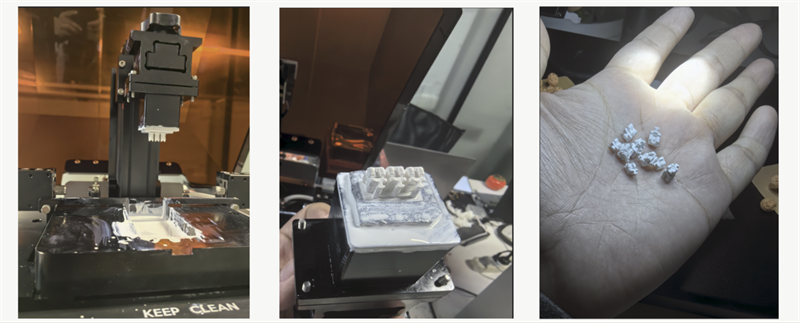
Green bodies on the build platform and a close-up of a single as-printed part
Washing: keep the accuracy you just printed
Uncured slurry clings to the green body. Wash too aggressively and thin wings and undercuts lose material. Wash too little and the sintered slot fills with nodules. On a part this small, with this many recesses, washing is the second accuracy gate — not a casual cleanup.
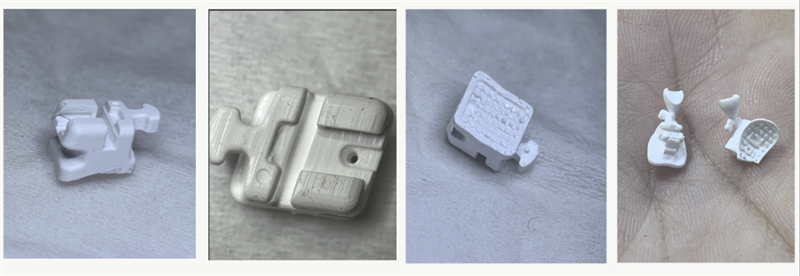
Washed green body, close-up of slot, wings and base
Debinding and sintering: from a white body to zirconia
Organics leave the part and the ceramic densifies at high temperature. Shrinkage is substantial. The CAD model must be scaled to a measured shrink factor, and the print orientation and setter arrangement should stay fixed. Otherwise labial wing symmetry and lingual base curvature drift. After sintering the part is no longer a resin–ceramic composite. It is dense zirconia — color, sheen and feel all change.
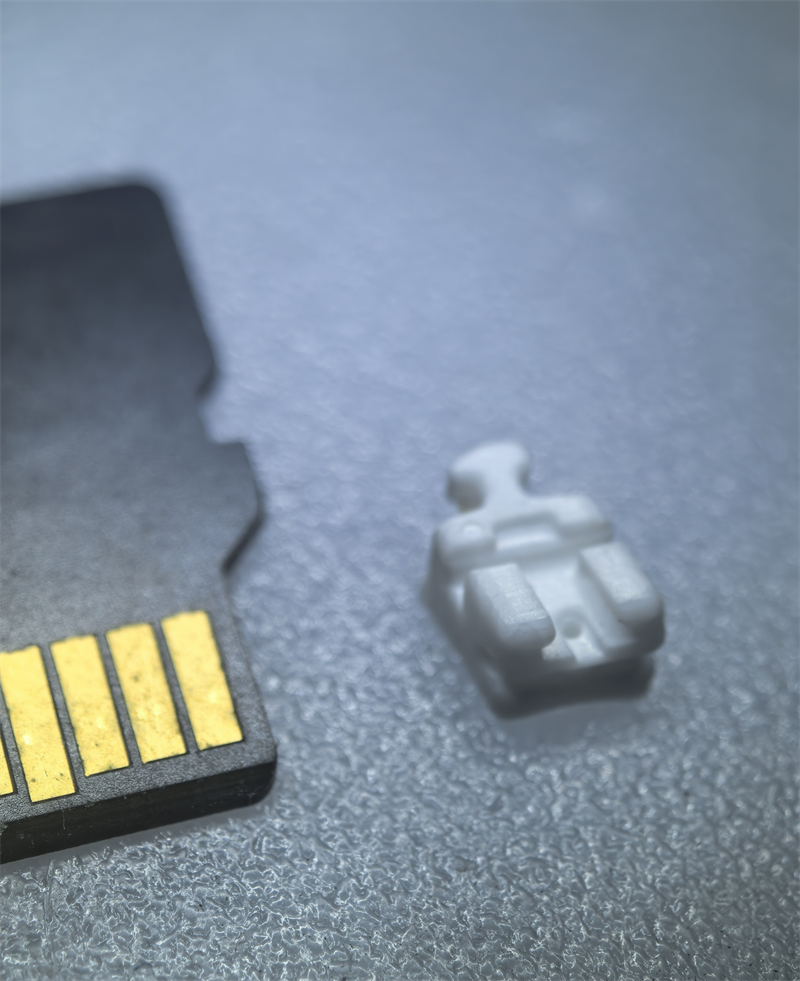
Sintered zirconia bracket. The memory card gives an immediate reading of absolute size and edge sharpness.
For an orthodontist or a lab, precision is not a microscope image. It is whether these things happen reliably:
1. The slot seats. The wire goes in cleanly and does not feel oddly loose or tight after ligation.
2. Wings and undercuts survive. Tie-wings are not broken or flooded; hook and ligation space remain as designed.
3. The base is designable. Mesh, micropores or grooves can be printed with the body in one piece — no secondary bond or secondary machining just to get a complex pad.
If the only goal is to copy an existing injection-molded part, 3D printing adds little. The real gap it opens is in the pace of design and validation.
• Change the structure without waiting for a mold. Slot size, base curvature, wing thickness, presence of a hook — edit the model and print.
• Small batches can still be serious. Ten or twenty pieces are enough for bond tests, wire-seating tests and comfort checks, without betting a tool set first.
• Run styles in parallel. Labial aesthetic, lingual low-profile, hooked variants and tooth-specific bases can share one build.
• Leave a door open for customization. If the base later follows an intraoral scan of the tooth, the process does not have to be reinvented. Only the input model changes.
Design freedom
Tooling punishes complex undercuts and thin walls. Vat-photopolymerized ceramics are more willing to accept parts that are structurally complex as long as the dimensions stay in control. Mesh retention on the base, internal lightening and tooth-specific envelopes all sit in that category.
We do not read 3D-printed zirconia brackets as “replace every injection-molded ceramic bracket tomorrow.” The realistic path has three layers.
Near term: freeze the product definition faster
A brand, a clinic network or a contract manufacturer can lock slot specification, base retention and appearance on printed parts first, then decide which SKUs go to tooling and which stay on printed short runs. Iteration moves from months toward weeks.
Mid term: labial aesthetics and lingual low profile on one process
Labial ceramic brackets are about appearance and handling. Lingual brackets are about being unseen, less irritating, and compatible with indirect bonding. The two lines want different envelopes and different base strategies, yet they can share slurry, print parameters and a sintering curve. That matters for a small team: you do not need a separate tooling family for each line.
Longer term: customized bases inside a digital treatment loop
Intraoral scanning has already turned the tooth face into a digital surface. If the bracket pad follows that surface, cement thickness becomes more uniform and positioning more repeatable. Few processes can make “a different base for every tooth” manufacturable. The same printer can also sit next to the rest of the digital chain — setup design, indirect-bonding trays, archwire plans — from data to an intraoral attachment.
A high-precision ceramic printer is not limited to brackets. Dentistry is full of small, hard, irregular zirconia parts. Once dimensional control and the biomaterial path are in place, the application surface widens on its own. We started with brackets because they are small enough and demanding enough to make the printer’s precision and flexibility obvious in a single object.
Copyright © Shenzhen 3KU Technology and Science Co., LTD. All Rights Reserved Privacy Policy Blog
 EN
EN
 AR
AR
 BG
BG
 HR
HR
 CS
CS
 DA
DA
 NL
NL
 FI
FI
 FR
FR
 DE
DE
 EL
EL
 HI
HI
 IT
IT
 JA
JA
 KO
KO
 NO
NO
 PL
PL
 PT
PT
 RO
RO
 RU
RU
 ES
ES
 SV
SV
 TL
TL
 IW
IW
 ID
ID
 SR
SR
 SK
SK
 SL
SL
 VI
VI
 ET
ET
 HU
HU
 TH
TH
 TR
TR
 FA
FA
 MS
MS
 GA
GA
 CY
CY
 BE
BE
 IS
IS
 MY
MY
